












December 2011 - Does Digital Finally Rock?
Personal Listening Experiences
with Three New DAC Designs
Early this year, I visited Poland's
capital of Warsaw for the first time. I accompanied my wife, who did an
interview there for her new book project, interviewing an elderly
Polish woman who had a fascinating story to tell. My part was the
recording of the interview, and everything worked fine for us. We both
were impressed with the hospitality of our Polish hosts and the beauty
of Warsaw. Hence, we enjoyed our short trip immensely.



Some pics of the beautifully rebuilt Warszaw old town
What I didn't know at that time (and learned some
time later from a Polish customer of my friend, the loudspeaker
designer David Haigner) was that Poland is a country of audio
connoisseurs and has a circle of highly-gifted audio designers, too.
There is a distributor of the famous Kondo Japan brand in Warsaw, for
example. I wish we had one here in Vienna, I have to admit! In
addition, Ancient Audio in Krakow is a highly-regarded Polish maker of
tube amps and CD players. There is also Lukasz Fikus in Warsaw, who
gained a lot of fame in internet fora due to his upgrades of CD players
and lately his own DAC designs under the Lampizator brand.
As I have been looking for an upgrade
of my trusted Martin Küng modified Micromega DAC, I have been closely
following the highly informative reviews on various DAC models on the 6moons internet-based audio-review site. Since the new DAC shooting star
has seemed to be the Metrum Acoustics Octave Mini DAC a non oversampling (NOS) DAC for roughly EUR 800,
which has been highly regarded by 6moons' chief-editor Srajan Ebean,
this Metrum DAC was definitely on my short-list of DACs to evaluate. It
came in handy that one of my trusted audio friends had ordered an
Octave Mini DAC for himself some time ago from Metrum Acoustics in the
Netherlands and had recently received it.
During my internet researches, I
found two other DAC designs which seemed highly interesting. One was
the above-mentioned Polish Lampizator DAC in its level 4 version, made
by Lukasz Fikus and his team in Warsaw. This DAC is also an NOS variant
and got an excellent review from the internet audio magazine Stereo Mojo; The article's photos demonstrate that the
built-quality of this DAC is highly impressive - don't get to excited
about the ladies they show, though ;-).
The Lampizator level 4 is a beefy DAC
with about 10 kilos weight due to a massive in-built power supply with
tube rectification, and it has an SE triode tube output stage. Mr.
Fikus performed extensive research to find out the best pairing of DAC
chip and receiver chip for his DAC designs and succeeded finally in
pairing a 32Bit DAC chip capable of up to 192 Khz sampling rates and an
industry receiver chip with superb musical results. The chip
combination - as he claims - has been never used in audio applications
before. This sounded convincing, so I emailed Mr. Fikus about my plans
to compare some highly interesting DACs and write about my findings. He
immediately offered to send me a level 4 DAC for evaluation. That was
great news indeed :-). Two weeks later, the Lampizator DAC level 4
arrived from Warsaw. This version came with two special quality E182CC
nos Philips double triode tubes in the output stage and Jensen copper
foil capacitors as an upgrade. Sale price of this Polish DAC is EUR
4,800 including VAT.
The other interesting design on my
short list was the Lenehan Audio PDX DAC, which has received excellent
feedback in audio forums and seems to have a lot of fans worldwide.
This design has also a tubed output stage and in its top notch version,
Duelund VSF coupling caps. The top version with VSF cap upgrade comes
up to roughly $ 4,000. Unfortunately, Down Under, where the Lenehan
Audio PDX DAC comes from, is really far away from Europe. As my audio
site is only a private and fun hobby, I decided to avoid expensive
shipping costs and possible customs issues and didn't contact Lenehan
Audio in Australia. For people interested, here is the website of
Lenehan Audio with a description of the PDX DAC.
As I felt that a third musical DAC
was needed for the comparison, this was clearly a job for Martin Küng's
new DAC model with additional asynchronous USB input (using a Tenor
7022 USB streamer chip with 24Bit / 96 Khz in asynchronous USB mode).
The DAC chip used is a BurrBrown PCM 1794, which works in asynchronous
upsampling mode to 24 Bit / 192 Khz. I called Martin and he immediately
agreed to lend me a unit for the comparison. Hence, we had one of the
upsampling DAC species to compare with the two NOS DACs. Great! The
Martin Küng design has a direct sale price of EUR 1,760 and thus
represents roughly the middle ground in pricing of the DACs compared.
|
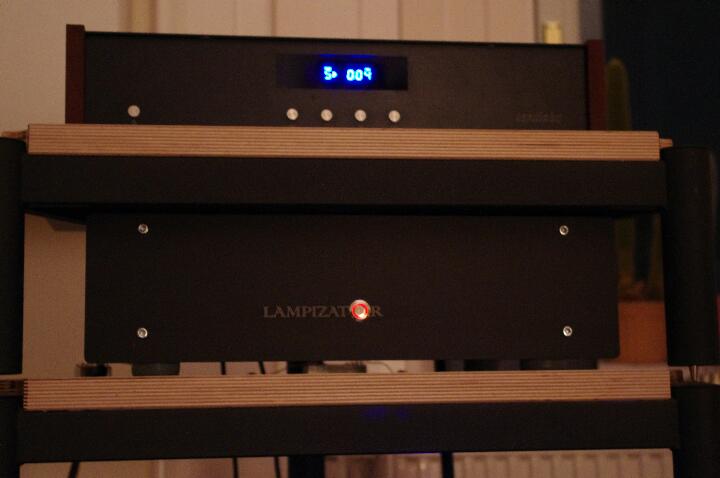
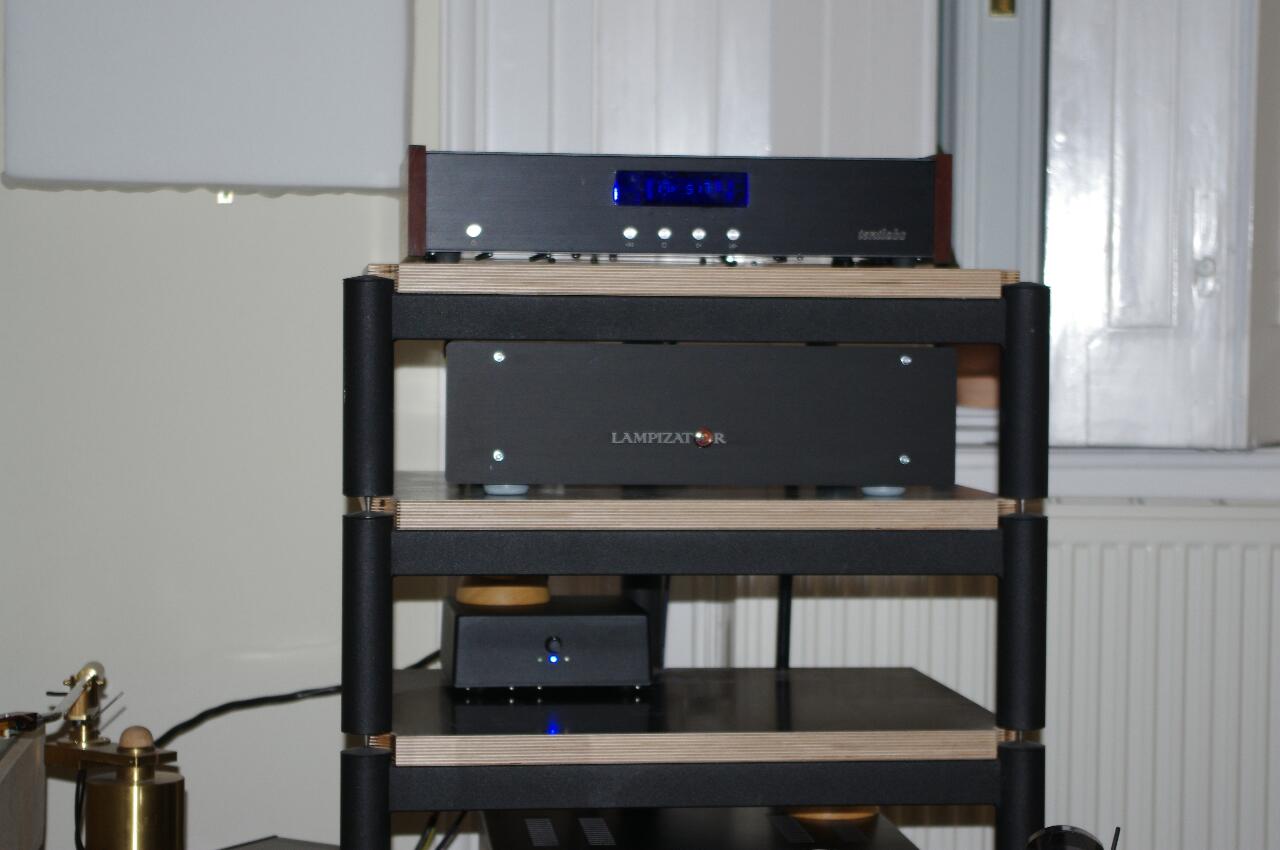
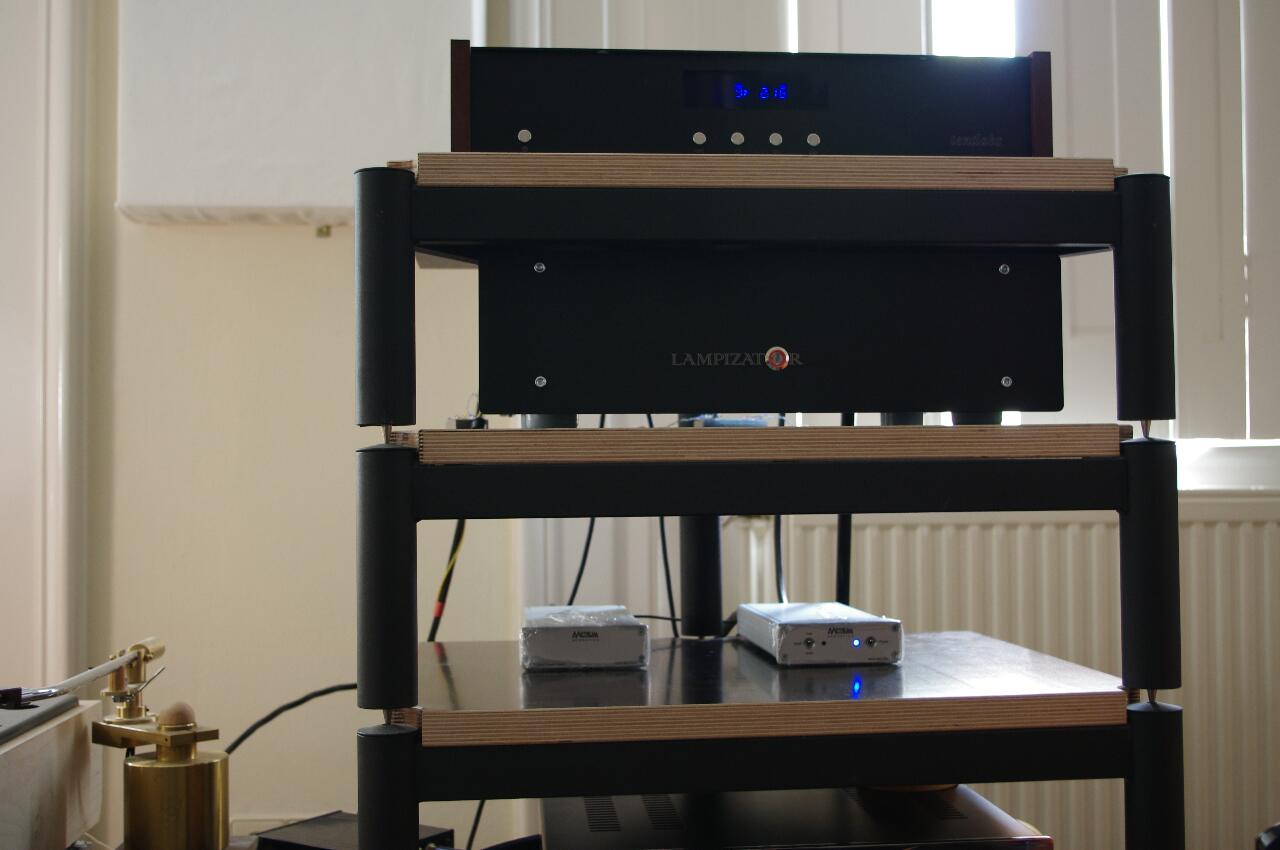
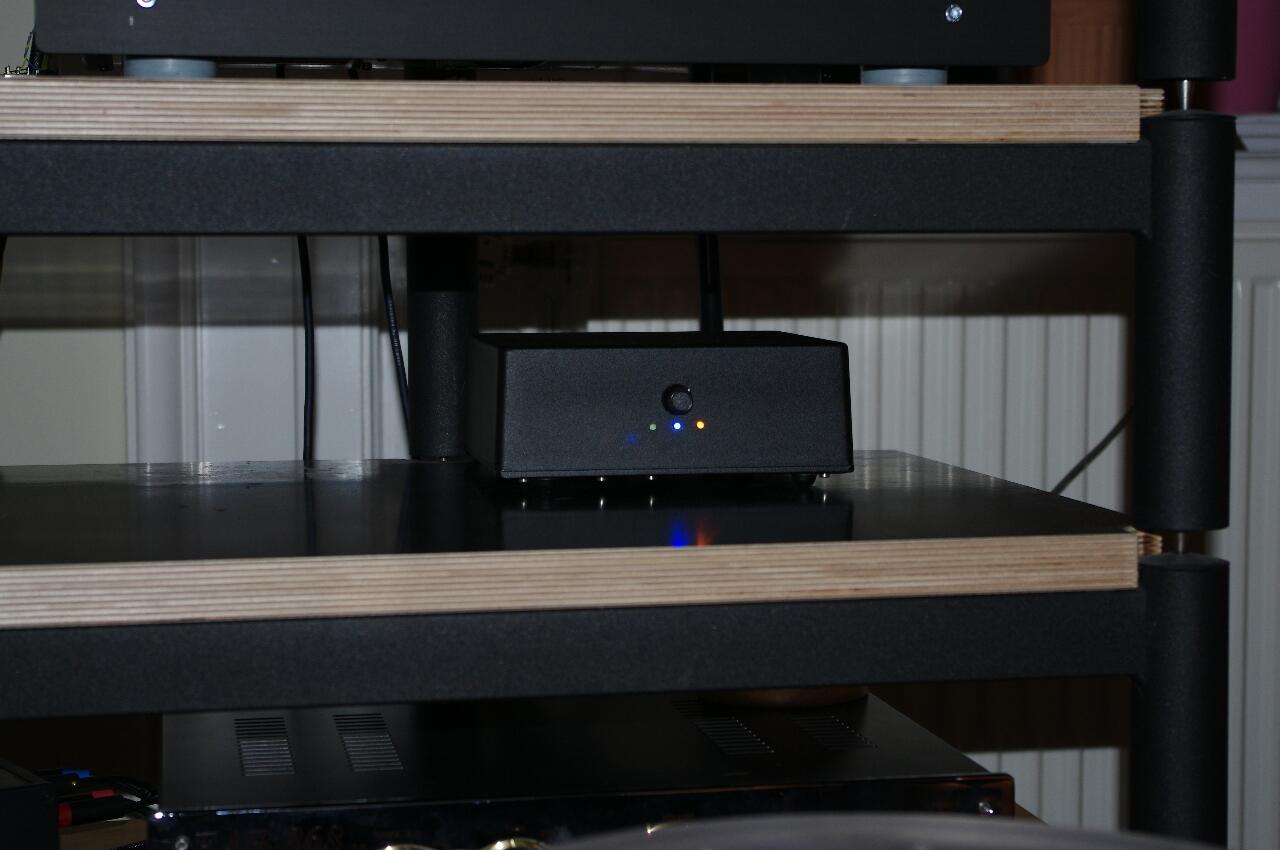
Tentlabs Drive on top, Lampizator DAC in the
middle and Martin Küng DAC below |
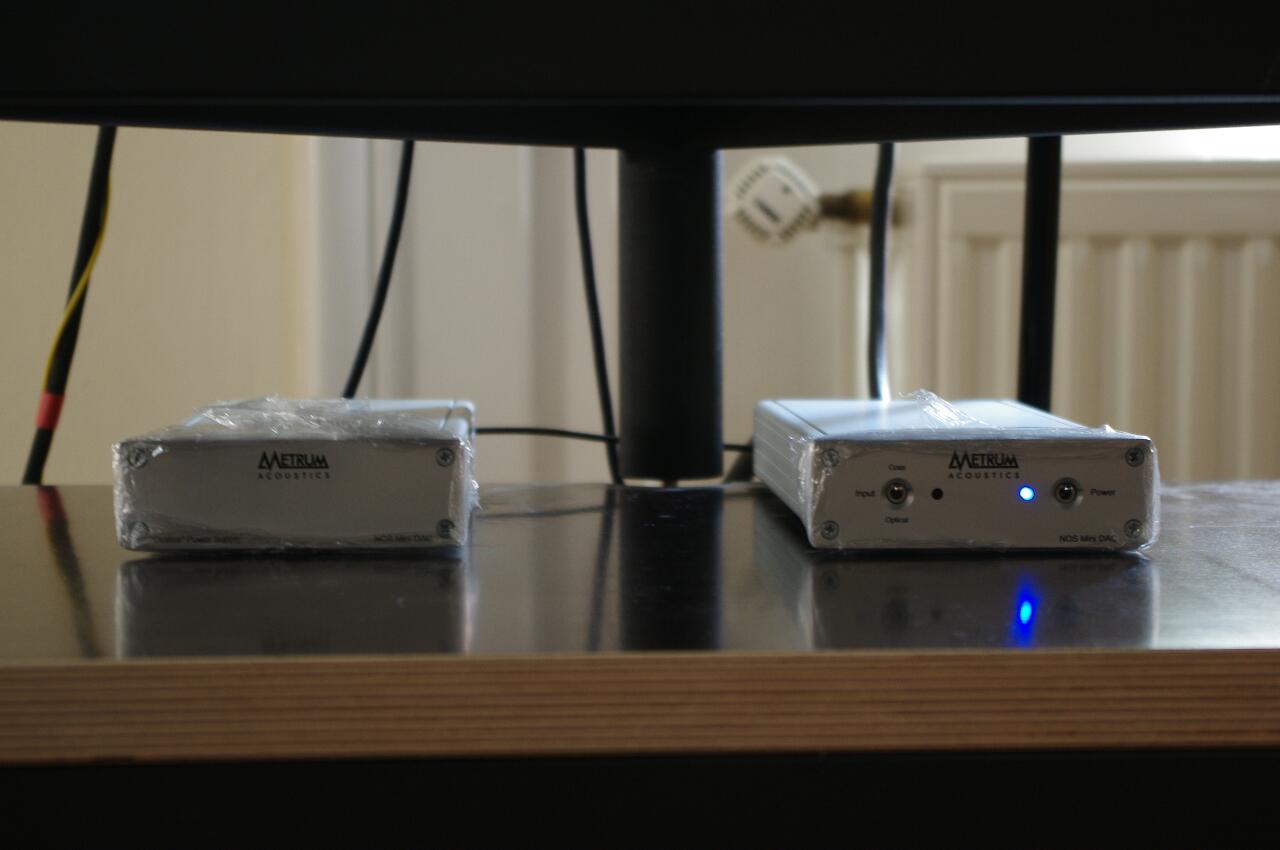
Metrum Acoustics Octave NOS Mini DAC (still partly wrapped in plastic foil) |
|
|
Martin Küng DAC with switchable inputs |
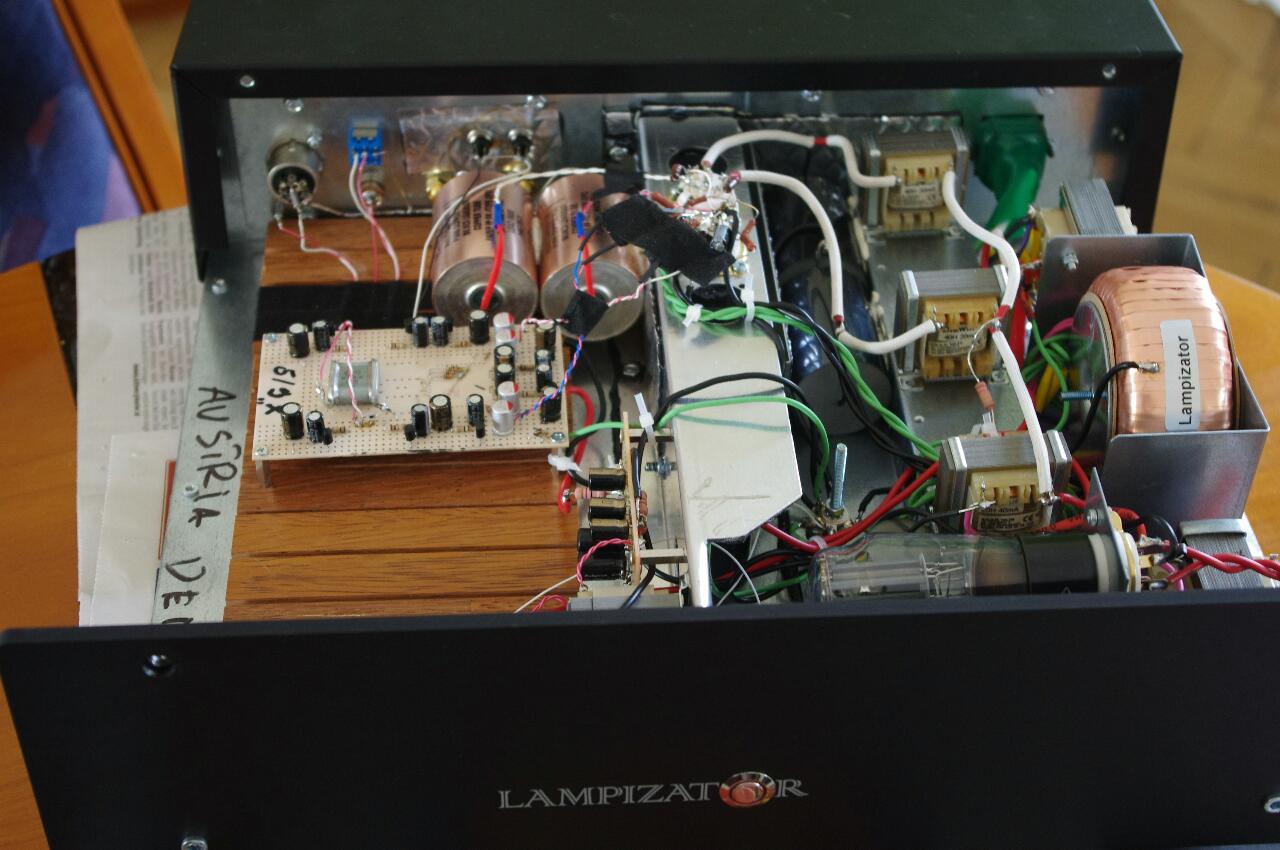
Inside view of Lampizator level 4 DAC.
On the left side, one can see the
massive Jensen copper foil caps behind the DAC board. On the right side
is the ps-section with rectifier tube in the front and massive power
transformer screened with copper foil. Everything is point-to-point
wired. :-)
So, that's for the contenders. One has to note
though, that all of them had low hours of usage during the time of my
evaluation, so were not at their best possible performance level yet;
as this was true for all three of them, however, I believe the
comparison was a fair one.
The comparison was done via SPDIF
connected to my Tentlabs CD player used as drive only (plus a
comparison of the Martin Küng DAC between SPDIF and USB inputs. For the
USB connection, I used my trusted Samsung Netbook and Jriver
MediaCenter 16 as source and some of the CDs mentioned below ripped to
hard disk). Amplification used was EAR 868 tube and FirstWatt B1
buffer-preamps feeding the Thomas Mayer 801 SE Triode amplifier.
Speakers used for the comparison were my new David Haigner 3-way Gamma
Horns.
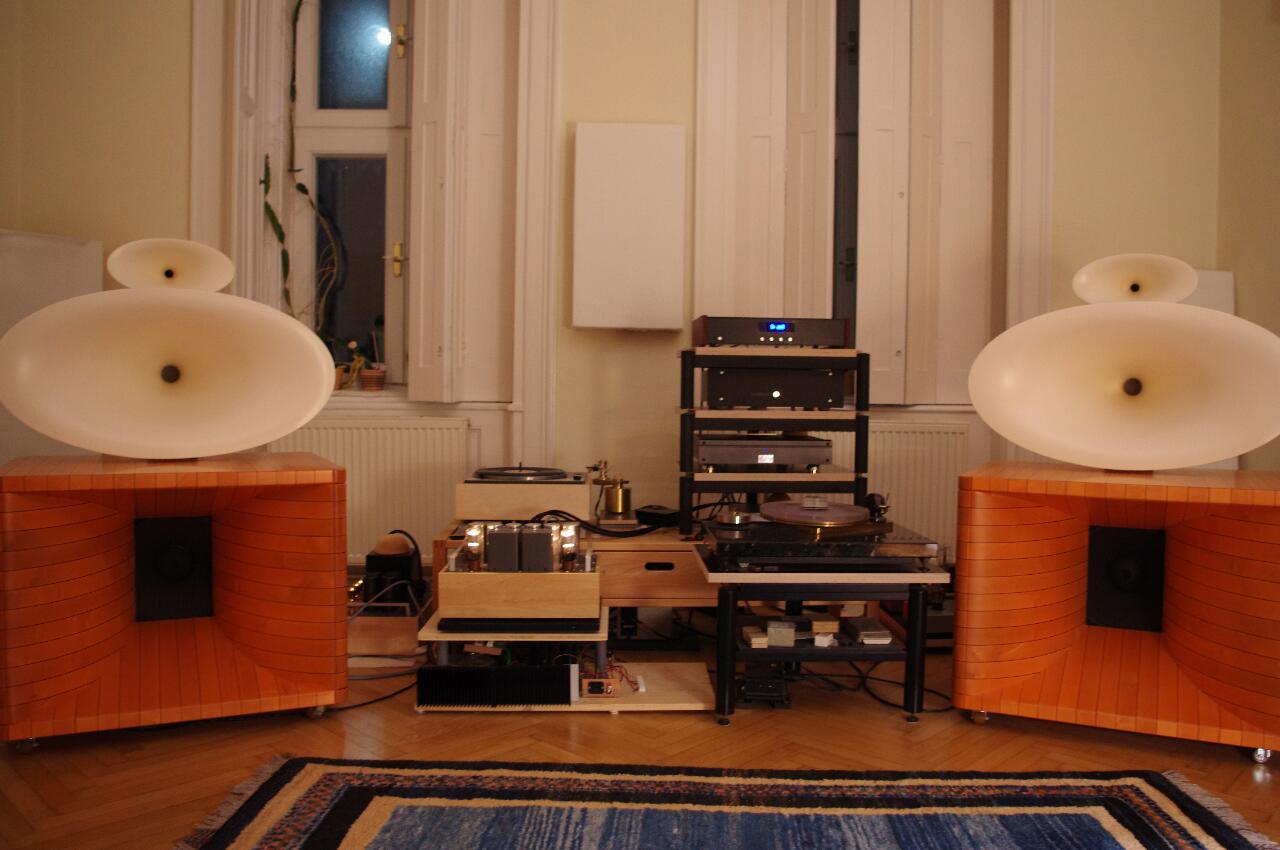
Music room and system
Music played ranged from pop to jazz to blues as well as to classical music. For example:
Treme / Music from the HBO Original Series, Season 1
(Geffen Records B0014910-02, tracks 15, 17 and 18), Ry Cooder / Pull up
Some Dust and Sit Down (Nonesuch Records Inc. 527407 (tracks 4 and 10),
Eric Clapton / Clapton (Reprise 9362-49635-92, tracks 5 and 14), Il
Labirinto Della Chitarra / Pierre Pitzl & Private Musicke (ACCENT
ACC 24239, tracks 1 - 3, 7 and 17), Bach H-minor Mass (BWV 232,
Celibidache, Munich Philharmonic, CD2, track 4) and Goran Bregovic /
Ederlezi (Mercury 558 350-2, tracks 4, 11 and 14)
Interestingly, the overall
differences were not as major as the differences in sale prices would
suggest. Thanks to my superb Gamma horns - this is another story I will
publish soon, I promise :-) - these differences in musical performances
were definitely audible though.
So, here are my findings:
Overall, I liked the Lampizator DAC
the most. It has a naturalness and openness which none of the other
DACs I compared it to can match. This results in wonderful air around
instruments, which especially with acoustic music, portrays a
holographic and extremely realistic picture of recorded music in one's
listening room. Take, for example, the wonderful track 17 of Pierre
Pitzl and Private Musicke playing guitar music from the 17th-century
Italy. The percussion section with all of its metallic nuances blends
in wonderfully in this energetic piece of music. Highly recommended CD
by the way, if you like early Baroque music.
Another example is track 18, the
famous second line funeral song "Just a Closer Walk with Thee" of the
Treme CD I mentioned above. This CD is only of mediocre sound quality,
which you can definitely hear with all three DACs. But with the
Lampizator's outstanding resolution, the brass section and big drum get
a slightly more realistic and three-dimensional touch, despite the
overall shortcomings of the recording, which helps to pull you more
into this fantastic second line tune, performed by one of the leading
New Orleans Brass Bands, the Treme Brass Band.
In comparison, the Metrum Acoustics
Octave Mini DAC is the most direct and forward sounding, with a
slightly darker and denser presentation than the Lampizator and with
excellent resolution. It doesn't deliver the outstanding stage depth of
the Lampizator design and there isn't as much air around instruments in
comparison to the latter, but it conveys a very believable picture of
the recording and its sound quality. To my ears, the difference between
the two DACs is mainly the sound of an excellent transistor design
versus one with a high-quality SE triode tube output stage.
The Martin Küng DAC is also a
transistor design based on a tricked out Op-amp output stage, has a tad
better stage depth than the Metrum and is a bit smoother. However, it
is also a bit more rounded at the top end (lower resolution) and less
energetic (compared to the Metrum and the Lampizator DAC). Fed via
Netbook and USB, the Martin Küng DAC improves resolution and treble
magic and reaches the level of the Metrum, but doesn't reach the
Lampizator's quality of openness and airiness around instruments. It
also still lacks a little bit of the energy the Metrum can convey. As a
result, the added asynchronous USB port is a good investment as it
increases the very musical performance of the Martin Küng design to a
level matching the performance of the Metrum DAC, although with a tad
less energetic reproduction. For a system more on the analytic side
with focus on resolution and detail, this would be the perfect partner,
in my opinion.
All three are musically very pleasing
DACs and involving when listening to digital music, with the Metrum
Acoustics DAC being a bargain considering price and performance level
and therefore, ranked as 2nd best in my comparison.
However, the Lampizator level 4 DAC
won my heart for its outstanding musical qualities, reproducing
acoustic instruments with the right amount of air around them, which is
rarely achieved with digital playback. This is an analogue-like
quality, and the Polish DAC is the one which comes closest to the
performance of my beloved vinyl rig. But it doesn't get fully there -
that has to be said. Maybe with high resolution files played from
a dedicated audio computer it is possible to equal the performance of
good vinyl equipment. That is something I will try out in the future
and will let you know.
Was there nothing to complain about
regarding the Lampizator DAC, you may ask. Well, there is only one
minor thing, and that is the relatively high output voltage of around
3V (2V being the standard for digital playback). This can result in
overdriving your preamplifier or the preamp-section of your amplifier,
which when it happens will definitely affect the sound in a negative
way. It was no problem with my EAR 868 tube preamp, but my First Watt
B1 J-Fet buffer preamp sounded a bit stressed with the Lampizator
connected as digital source. The good thing is that you can choose a
lower output voltage when ordering from Lukasz Fikus, and according to
Lukasz, it entails only a replacement of one resistor per channel to
reduce the voltage accordingly.
Fact is, the winner of this DAC
comparison is Lukasz Fikus' Lampizator level 4 DAC. When I told Lukasz
about my findings, he made me a generous offer to purchase this review
version, so I decided without hesitation to not let it go back to
Poland.
One thing has to be said though: When
you look at the price point of the three DACs compared, the Metrum
Acoustic Octave Mini DAC is incredibly good for the money and gets my
vote for being currently the ultimate bargain in audio. :-)
Performance-wise it comes very, very
close to the level of a superb DAC, such as the Lampizator, level 4.
Whether this small gap is worth a more than 5x higher asking price
(which is fully justified by the quality parts Lukasz Fikus puts into
his DAC design) is something the buyer must decide for him/herself . If
you have a high class audio system and you prefer to listen to
recordings of acoustic music, the Lampizator level 4 DAC has, in my
opinion, a strong calling card.
Musically Yours,
Norbert
PS: Martin Küng informed me recently,
that he has started working on a new output stage design, which should
increase the resolution of his DAC-design by quite a margin without
loss of its very pleasing musicality. I will get this version for an
audition early 2012 and will update you on my findings.
Update June 2012:
As promised Martin Küng loaned me
the latest verion of his DAC design for a two-week audition. The
somewhat understated visual appearance of the DAC is the same (see
photo above) but the output stage is now a discrete Fet-based one. And
this change makes the Küng DAC highly competitive, especially when you
consider that the price of EUR 1,760 including USB input stayed the
same. The slightly rounded top end and the small lack in energy of the
former Op-amp output stage version are gone. With the latest Fet-based
version one can hear deeper into the recording without getting lost in
details.
Resolution definitely increased at both frequency extremes, for example an acoustic bass line has more grip and weight and is easier to follow in the mix, of course depending on the recording quality of the piece of music. Musicality and 3D-images - a plus of the former version - remain strong points. In comparison to my Lampizator DAC, the performance gap between the two is further reduced. At the end of the day, the Lampizator stays my favorite DAC with its slightly bigger image size of instruments, tiny bit more dynamic slam and this special tube magic, which is so hard to describe and normally can't be found with transistor designs. But for the money and up to double the price point, the Fet output-staged Küng DAC is a fantastic performer. Highly recommended!
As Martin informed me, a new chassis is in the works to improve the understated optics a notch. ;-)
©The
Audio Eagle 2005-2013
• All Rights Reserved • Disclaimer